- Chose
- In-memory JavaScript transformers, using Map dictionaries for lookups.
- Instead of
- Joining the datasets in the browser with AlaSQL.
- Why
- The AlaSQL joins rescanned the right-hand array once per left-hand row, which is quadratic work, and the tab froze on a few thousand rows. Building a Map once and looking up by key is a single pass and constant-time per row, which took aggregations from minutes to milliseconds. The cost is that the join logic is now hand-written rather than declarative, so it needs comments a SQL join would not.
WorkInternal tool
Claims escalation and task portal
Commure · 2026
An internal application that runs the full lifecycle of a claim escalation, from staging through triage, assignment, review, and close, for a team spread across two timezones. It replaced end-of-day arithmetic done by hand with a report the system generates, and gave taskers the one thing they had never had: the complete history of what had already been tried on a claim.
RetoolPostgreSQLSQLJavaScript
Employer work, described in general terms. The screenshots have all real data blacked out: the tool handles patient information protected under HIPAA, and the rest is restricted. Internal names, counts and vendor names are hidden.
The problem
Escalations arrived faster than anyone could track them. Assignment lived in spreadsheets, progress lived in people's heads, and end-of-day SLA reporting was manual arithmetic performed by tired people at the end of a shift, which is exactly when arithmetic goes wrong. Worst of all, a tasker picking up a claim had no way to see what had already been attempted on it, so calls got made twice and the same portal got checked by two people on the same afternoon.
The system
Staging
arrives, unassigned
Triage
categorised, prioritised
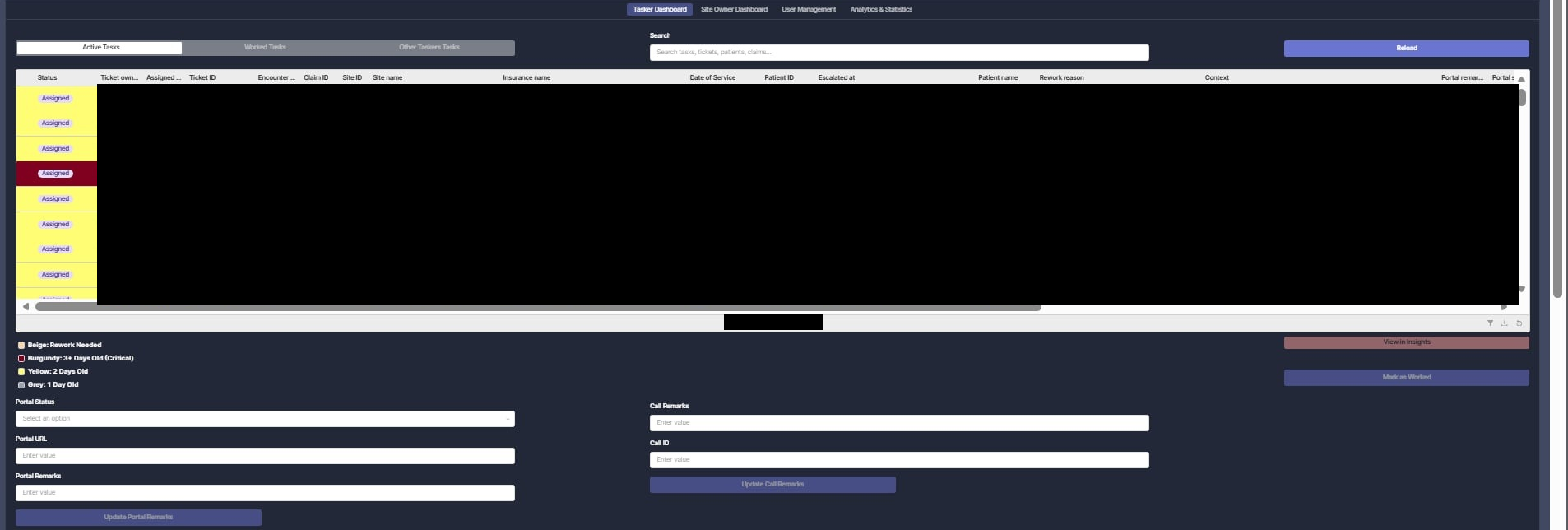
Tasker dashboard
worked, with history
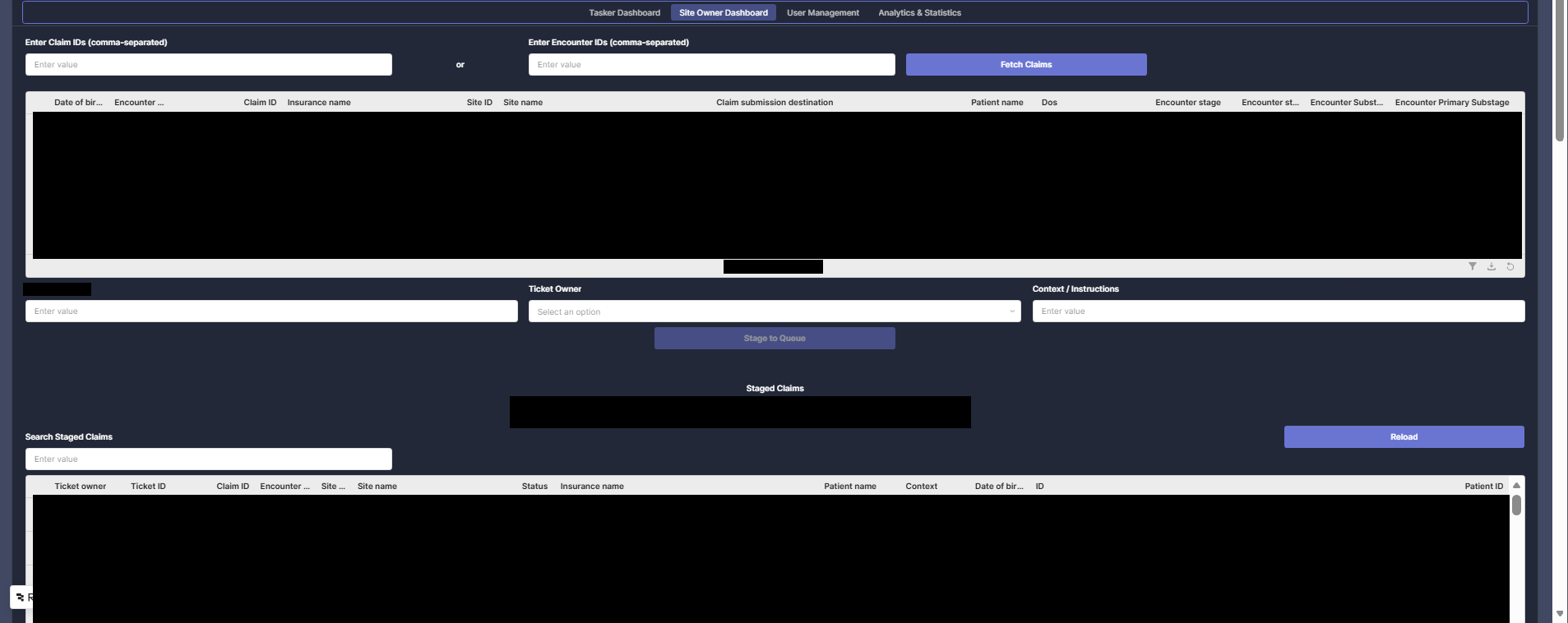
Site owner QA
reviewed
Closed
historical, searchable
A five-stage lifecycle
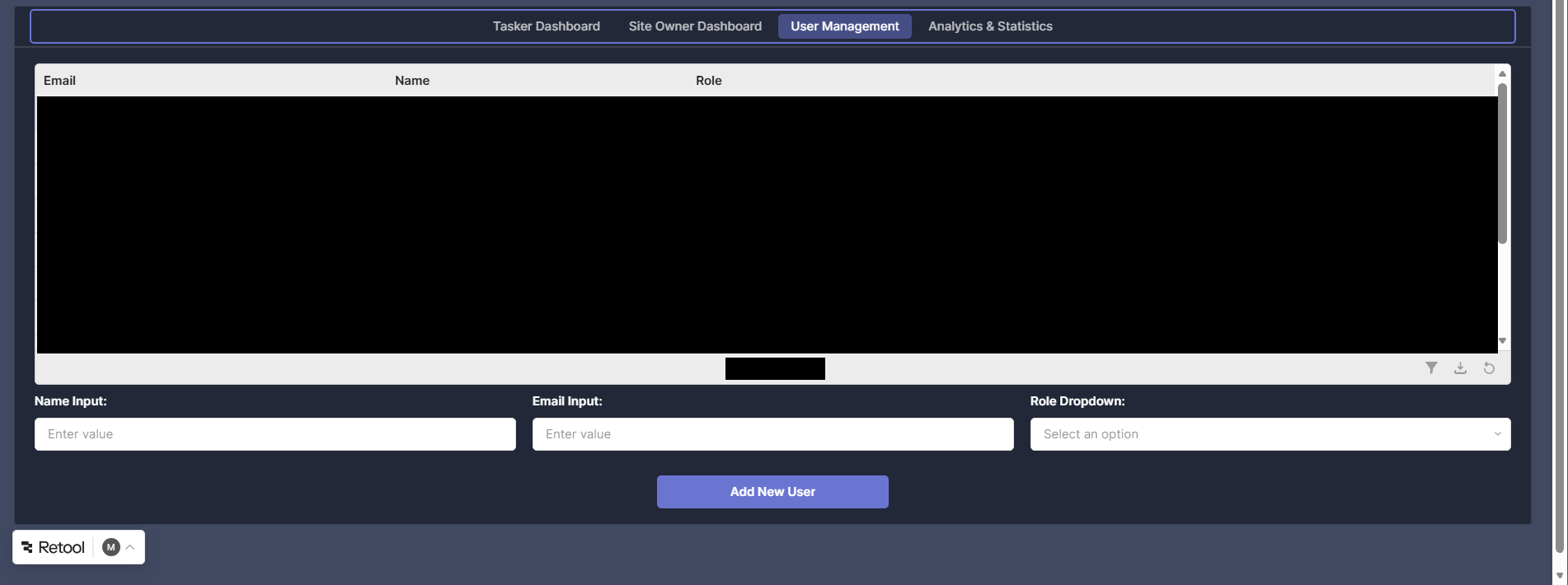
Every claim moves through staging, triage, the tasker dashboard, site-owner QA, and close. Stages are explicit rather than implied by a status column, because an explicit stage is something you can attach permissions, timestamps, and a queue to. Role-based access decides which stages a given person can even see.
SLA tracking as a rolling window
The reporting engine evaluates each ticket against a rolling window (assigned more than fifteen hours ago, worked within the last twelve) rather than against a calendar day. It resolves fractional progress correctly, so a parent ticket with four of ten claims worked reports as four of ten rather than as done or not-done, and formats the result as text a tasker pastes straight into Slack.
Master–detail history
Selecting one or several claims loads their full chronological history into a second table: which portals were visited, which representatives were reached, call reference numbers, and prior rejection reasons. This is the feature that changed how the job felt, and it is nothing more than a well-indexed join surfaced at the right moment.
Bulk actions with guard rails
Leadership can assign, update, or delete across many rows at once. Every bulk control disables itself on an empty selection, so a mis-click cannot reach the database at all.
Technical decisions
What was chosen, what was chosen against, and what the trade cost.
- Chose
- Store everything in UTC; convert at the edges with AT TIME ZONE in PostgreSQL and moment-timezone in the UI.
- Instead of
- Storing local timestamps, which is what everyone reaches for.
- Why
- The team spans Dhaka and Los Angeles, and the SLA is a rolling window rather than a calendar day, so the two never line up. Local storage is also wrong twice a year: daylight saving means the offset is not a constant, so one hour is duplicated and another does not exist. UTC in the database with conversion at the boundary is the only version that survives March and November.
- Chose
- Partial updates written through COALESCE.
- Instead of
- Writing the whole row on every save.
- Why
- Several stages write to the same claim, sometimes close together. A full-row write from a client holding a stale copy silently reverts whatever another stage just set, which is the worst class of bug, because nothing errors and the data simply becomes wrong. COALESCE lets a stage update only the fields it owns and leave every other field untouched.
- Chose
- Disabling bulk controls when the selection is empty.
- Instead of
- Validating on the server and returning an error.
- Why
- Server validation is still there, but a control that cannot be pressed is a better guard than an error message. A bulk statement built from an empty selection either fails loudly or, depending on how the predicate is assembled, matches every row, and the second outcome is not one you want to discover in production.
The result
End-of-day reporting stopped being arithmetic and became a button. Aged claims that had been invisible became a queue anyone could see, and the history panel meant taskers stopped repeating calls that had already been made. The honest summary is that none of this is clever software. It is ordinary software applied to a process that had been running on spreadsheets and memory, which turns out to be where most of the value in internal tools actually is.